
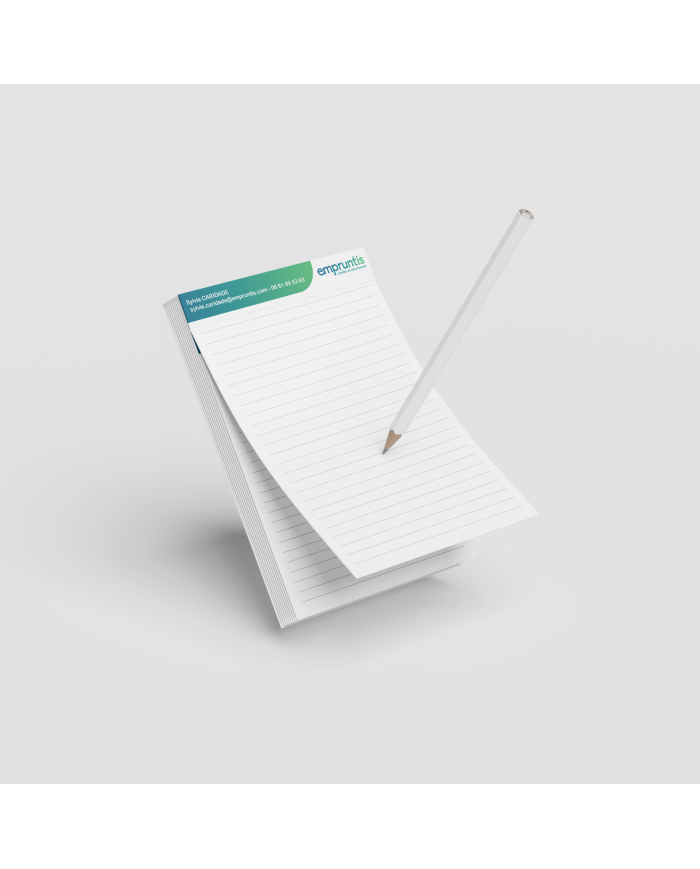


Which paper suits your notepads?
Two inner papers are offered. The 90 gsm offset sheet is uncoated and slightly textured: ballpoint grips it, fibre tips barely bleed and pencil leaves a clean line. It is the stock for pads that are genuinely written on, every day. The 80 gsm recycled sheet is lighter and less bright white, writes just as well and states your position from the first page. The cover follows: 170 gsm matt coated protects the pad without stiffening it, 300 gsm matt coated and Premium 300 gsm act as a firm base under the hand, and the matching-inner option gives a plain pad with no separate cover at all.
Available sizes
A4 works as a meeting pad, with room for a table or a sketch. A5 slips into a bag and covers everyday note taking. A6 and A7 sit beside a till or a switchboard for a number jotted down in a hurry. DL, long and narrow, fits a window envelope and suits checklists, service records and bills. You will find the full range in our notepad section, part of our personalised stationery.
Binding, rings and sheet counts
A glued pad, bound along the top or the left edge over a board back, releases one sheet at a time: this is the format to hand out. Wire binding, with black, white or silver rings on the left edge or the head, lets pages fold right back and keeps the pad open on the desk. Sheet counts run 25, 50, 100 or 200, depending on how long the pad has to last.
Preparing your artwork
300 DPI, CMYK, 2 mm of bleed and a 4 mm safety margin. Leave the glued or punched edge clear, at the head or on the left according to the binding you pick. A discreet header and a footer with your contact details are usually enough: the writing area should stay free.
2M Numérique at your side
Your notepads are made in our workshop in Manciet, in the Gers, south-west France: 100% Made In Occitanie, a choice we set out in our responsible approach. Tell us how the pads will be used and we will help you weigh up paper, binding and sheet count.
 Français
 English
 Español