

Which paper for your invitation cards?
350 gsm silk coated board is the starting point: rigid, with a lightly satin surface that keeps photographs sharp and colours clean. The 300 gsm recycled and 283 gsm kraft Raw move towards raw material, where ink reads softer, which suits community events and invitations with a natural tone. Fine art papers change the register altogether: Rives Tradition 250 gsm and Rives Design 250 gsm bring a felt grain under the fingers, Gmund Hanf 320 gsm and Gmund Stroh 300 gsm show their fibres, and Crush Mais 350 gsm carries visible plant residue. On these uncoated stocks, contrasted typography works better than a photographic solid.
Available sizes
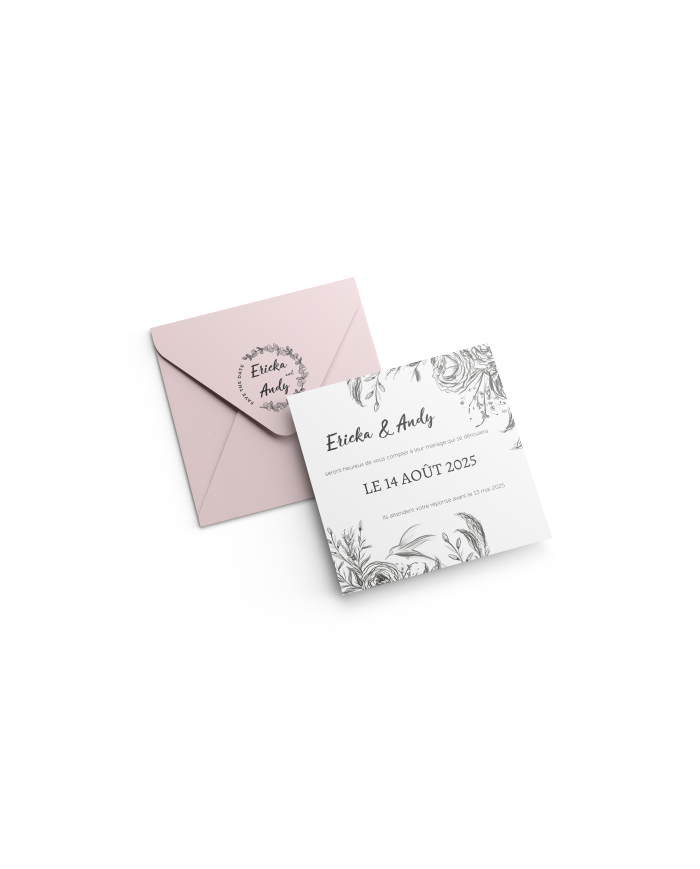
DL, 99 x 210 mm, is the long format that fits a common envelope, in portrait or landscape. A6, 105 x 148 mm, is the postcard style invitation, easy to handle and equally available portrait or landscape. A5, 148 x 210 mm, leaves room for a map, a programme or a reply slip. The 148 x 148 mm square, offered in two variants, steps away from the expected shapes and stands out in a pile of post.
Finishes, folding and envelopes
Print single sided or double sided, flat or with a single fold that doubles your text area. Gloss, matt or soft touch lamination protects the card and settles its feel. Spot varnish, flat or 3D, lifts a monogram or a headline. Gold or silver foiling on the front keeps the shine for a few elements. Matching envelopes come in white, blue, pink, gold and silver, or none at all if you hand the cards over in person.
Preparing your file
Supply a PDF at 300 DPI in CMYK, with 2 mm bleed and a 4 mm safety margin. Spot varnish and foiling areas belong on a separate layer, as solids, so the press knows exactly where to work.
2M Numerique at your side
Your invitation cards are made in Manciet: 100% Made In Occitanie, and the reasoning behind it is set out in our responsible approach. Our team helps you match paper, finish and envelope, as on every job in our print works and across the card range.
 Français
 English
 Español