
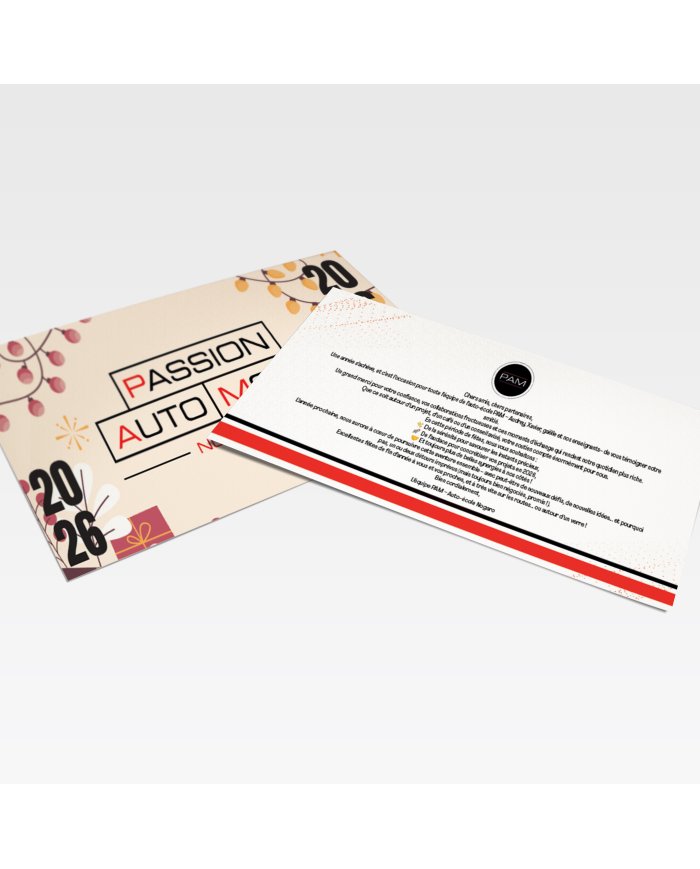


Which paper for your postcards?
A postcard travels: it changes hands, sometimes through the post, without an envelope. Silk coated 350 gsm is the most versatile, thick enough not to curl and neutral enough to carry a photograph. Recycled 300 gsm gives a matt surface and a slightly broken white, which appeals to businesses talking about their commitments. Raw kraft 283 gsm takes that further, with a natural shade that softens process colours. The creative papers, Rives Tradition, Rives Design, Gmund Hanf 320 gsm, Gmund Wheat 300 gsm and Crush Maize 350 gsm, suit shorter runs where the material is part of the message. On all of them the back stays writable as long as it is not laminated.
Available formats
A6 is the reference postcard size: pocket-sized, easy to post and easy to stack on a display.
The 14.8 x 14.8 cm square stands out by its shape. It works for a single image, a save the date or a keepsake card. Both sizes are listed in our personalised postcards category.
Finishes and double-sided printing
Double-sided is the usual choice: image on the front, message and address on the back. If anyone will write by hand, laminate the front only. Laminating both sides seals the surface and pens no longer take. Matt lamination calms the colours, gloss intensifies them, soft touch adds a velvet feel. Spot UV, flat or 3D, lifts a logo or a headline, and gold or silver foiling keeps that effect for special runs. More options sit in our cards range.
Preparing your artwork
Supply a 300 DPI CMYK file with 2 mm bleed and a 4 mm safety margin. Keep the back readable: a busy background makes handwriting hard to read. Outline your fonts and put spot UV or foil areas on a separate layer.
2M Numérique alongside you
Your postcards come out of our workshop in Manciet, in the Gers, 100 % Made In Occitanie, which is what our responsible approach is about. We check your file before printing and tell you if anything sits too close to the trim.

 Français
 English
 Español