
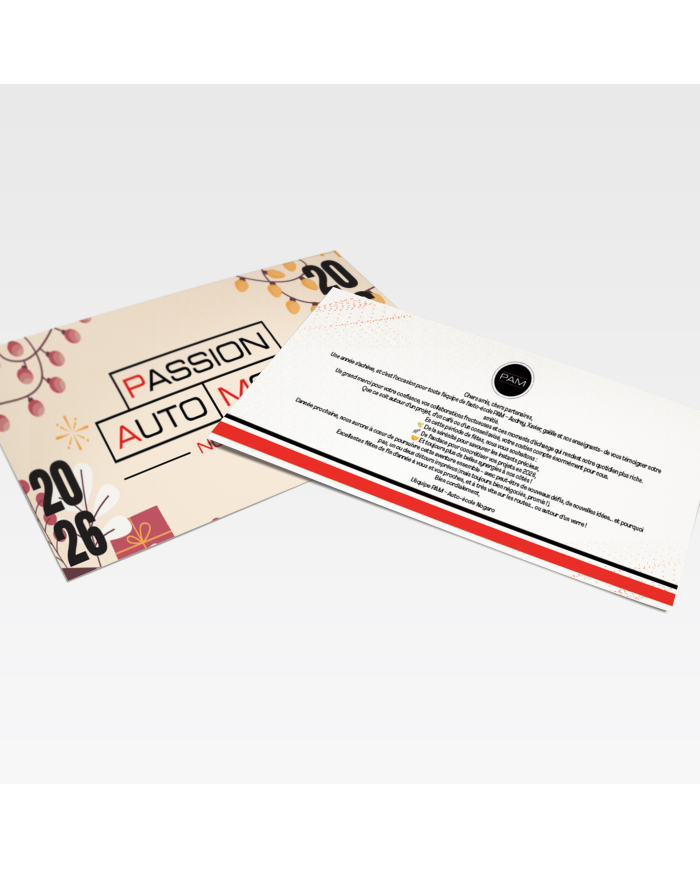


Which paper for your correspondence cards?
Weight sets the tone before a word is read. The 250 gsm silk coated stock suits most uses: smooth surface, faithful colours, and you can still write on it by hand. The 350 gsm silk coated version is stiffer and travels better. The 250 gsm gloss coated stock lifts photographs and solid colours. Recycled 300 gsm and Raw kraft 283 gsm show their fibres and stay matt, which suits a plain signature. The creative range goes further: the soft grain of Rives Tradition and Rives Design, the plant fibres of Gmund Hanf 320 gsm and Wheat 300 gsm, the maize flecks of Crush 350 gsm. The full range sits in our stationery cards section.
Available formats
DL follows the long proportions of a standard envelope and holds a short message without losing it in white space.
DL portrait puts the logo at the top and leaves room for a signature at the foot of the card.
DL landscape works well for thank-you notes and for cards enclosed with a delivery.
Finishes and double-sided printing
Print one side only for a handwritten note, or both sides to keep your contact details on the back. A single fold turns the card into a folded card with a blank inside. Spot UV, flat or 3D, brings out a motif through contrast of gloss; gold or silver foiling picks out a monogram. Gloss, matt or soft touch lamination protects the surface and changes the feel. Blue, gold, pink, silver or white envelopes complete the set. Other options are listed in our personalised correspondence cards category.
Preparing your artwork
Work at 300 DPI in CMYK, add 2 mm bleed on every edge and keep a 4 mm safety margin around text. Outline your fonts. For spot UV or foiling, supply the treated area on a separate layer, as a solid black shape.
2M Numérique alongside you
Your correspondence cards are produced in our workshop in Manciet, in the Gers: 100 % Made In Occitanie, part of our responsible approach. Unsure which creative paper to choose? Describe your project and we will put together a tailored quotation.
 Français
 English
 Español