Flocking, Screen Printing or DTF: Which Technique Should You Choose for Your Custom Textiles?
- 03 Jun, 2026
You have a design, garments to mark, and a deadline. The real question is: which personalisation technique should you choose? Flocking, screen printing, DTF : these three processes are not interchangeable, and the right choice depends on your project. It comes down to quantity, the visual effect (solid colour or photo), the type of fabric, and the durability you need. This guide helps you decide, criterion by criterion. Our workshop in Manciet (32) masters all these techniques in-house : we'll always point you toward the one that serves your project, not the other way round.
The three techniques at a glance
Before we compare, let's lay out the basics. Each process has its own logic, which determines what it's best suited for.
Flocking: precision for small runs
How it works. A film of material (flocked or smooth vinyl) is cut to the exact shape of the design, then heat-pressed onto the fabric.
Strengths.
- Crisp, opaque finish, even on dark fabric
- Excellent value for money from a single piece or a very small run
- Velvet-textured (flock) or glossy finish available, ideal for numbers, names and simple logos
- Excellent wash durability
Limitations. Flocking doesn't handle complex visuals well : each colour requires a separate film, so beyond 2 or 3 colours, both cost and time climb. Gradients and photos are out of reach.
Best for ? One-off or small-run personalisation : flocked names on club kit, jersey numbers, one- or two-colour logos, event t-shirts in small quantities.
Screen printing: the go-to for large volumes
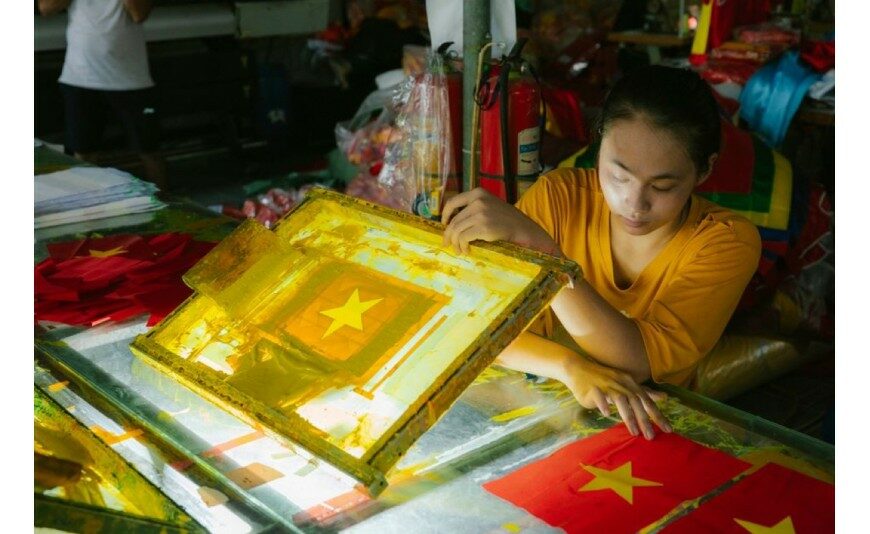
How it works. A stencil (screen) is created for each colour, and ink is pushed through the mesh, layer by layer, straight into the fabric fibres.
Strengths.
- Bold, vivid colours, with the ink worked into the fabric
- Remarkable durability : quality screen printing often outlasts 100 washes
- Unbeatable unit cost at high volumes
- Soft hand feel and a very professional result on solid colours
Limitations. Creating the screens involves a fixed cost : screen printing only becomes worthwhile from a certain volume upward, rarely for a handful of pieces. Like flocking, it's designed for a limited number of colours : photo visuals or gradient-rich designs aren't its strong suit.
Best for ? Large runs with a fixed design and few colours : company t-shirts produced in series, promotional garments, association collections, orders of several dozen or several hundred identical pieces.
DTF: what it is, and why everyone's talking about it
How it works. DTF stands for Direct To Film. The design is printed in full colour onto a special film, coated with a heat-activated adhesive powder, then transferred onto the fabric with a heat press.
DTF is the rising star of textile printing, and that's no accident. It combines three advantages that classic processes don't offer together :
- Unlimited colours. Photos, gradients, complex visuals : anything goes, with no extra cost per colour since printing is done in full CMYK.
- Small runs stay affordable. No screen or film to cut per colour : producing a single piece or fifty different designs remains accessible.
- Fabric versatility. DTF transfers adhere to most materials : cotton, polyester, blends, technical fabrics, light or dark.
Durability. Contrary to a common assumption, DTF holds up very well in the wash : prints commonly withstand more than 50 washes without cracking or fading, a level comparable to the best techniques for everyday use.
Limitations. The unit cost doesn't fall as much as screen printing on very large volumes : at several hundred copies of the same simple solid-colour design, screen printing regains the economic advantage. The feel of the transfer is also slightly noticeable on very large surface areas.
Best for ? The Swiss Army knife of modern personalisation : photo or multicolour visuals, gradients, small and medium runs, varied collections (every piece different), prototypes and quick reprints. It's often the best choice when the design is rich in detail or the quantity is modest.
How to choose, in practice
To decide without getting it wrong, ask yourself three questions, in this order.
- How many pieces? A handful : flocking or DTF. Several hundred identical pieces : screen printing becomes unbeatable.
- What visual? A photo, gradients, lots of colours : DTF is the obvious choice. A simple 1- or 2-colour logo : flocking (small run) or screen printing (volume).
- What fabric and what use? A technical fabric or delicate material, heavy washing : the process gets matched to the fibre. This is where a workshop's advice makes all the difference.
Beyond these three printing techniques, embroidery remains the highest-quality, longest-lasting solution for logos on polo shirts, caps and workwear. Find our full range of expertise on our textile services page.
Summary table: which technique for which project
| Technique | Ideal Use | Run Size | Visual | Durability |
|---|---|---|---|---|
| Flocking | Names, numbers, simple logos | Single piece to small run | 1 to 3 colours, solid areas | Very good |
| Screen printing | Company runs, promotional garments | Large volumes | Solid colours, few colours | Excellent (100+ washes) |
| DTF | Photo visuals, varied collections | Small to medium run | Unlimited colours, gradients | Very good (50+ washes) |
A workshop that masters all four techniques
At 2M Numérique, in Manciet in the Gers, we handle flocking, screen printing, embroidery and DTF all in-house. This full range is a real asset for you : we're not wedded to any single process, so we always recommend the one that genuinely matches your quantity, your visual, your fabric and your budget. Our garments come from TopTex, our regional supplier near Toulouse, for short lead times and a wide choice of materials.
Still unsure which technique best suits your project ? Tell us what you need and get a free quote within 72 hours : we'll advise you on the ideal process and price your textile personalisation with no obligation.
Further reading
- 30 Jul 2026Signage and window graphics regulation: 2026 guide (Gers, Landes)
- 01 Jul 2026Mandatory Notices on Your Printed Materials | 2M Numérique
- 04 Jun 2026Roll-Up or Kakemono: Which One for a Stand?
- 04 Jun 2026Rigid Panel or Banner: Which Outdoor Material?
- 04 Jun 2026Adhesive Labels: Paper or Vinyl, How to Choose
 Français
 English
 Español